

Plagiarism Detection with Turnitin
Let’s be real: if you work with student work long enough, you develop a sixth sense for “something’s off.” Still, gut instinct isn’t policy. Plagiarism detection is how you protect academic integrity at scale—whether you’re in higher education grading a stack of student submissions or running a content team that publishes daily.
The right plagiarism prevention service catches the messy stuff (paraphrase soup, recycled intros, AI-glossed paragraphs) and gives you clear originality reports you can stand behind. Articles, essays, and research papers are commonly checked for plagiarism using these tools. Turnitin and similar platforms make it easy for teachers and students to access submitted papers and originality reports directly within their virtual learning environments.
Turnitin’s been the default for years. It checks submissions against a vast database of academic work and internet sources to ensure originality.
Modern plagiarism detection relies on advanced technology, including artificial intelligence, to identify unoriginal or AI-generated content. But it’s not the only route, especially if you want faster workflows, better UX, or stronger AI signals. Let’s talk Turnitin alternatives that don’t feel like 2015.

Why the right detector actually matters
Here’s the deal: the wrong plagiarism checker wastes time and still misses things. The right one helps you…
- Assess student work and assignments quickly without sacrificing rigor.
- Catch accidental plagiarism before it becomes a hearing.
- Detect plagiarism effectively as a key function, ensuring academic integrity across all types of submissions.
- Flag AI writing credibly (and explainably).
- Foster original thinking by turning reports into teachable moments—so students improve, not just cross their fingers.
- Help with spelling errors and overall writing improvement, not just plagiarism.
And yes, detectors aren’t perfect.
Use them as decision support, not judge and jury. (Even mainstream coverage has shown how shaky some AI flags can be—and how students are adapting to “write for detectors,” which nobody wants. The Wall Street Journal)
Top Picks — quick comparison (for skimmers & spreadsheets)
Many plagiarism detection solutions are now integrated into learning management systems and other educational platforms, making them easy to use within existing workflows.
These tools can typically be accessed directly through their website, and some compare submitted content against other websites to ensure comprehensive checks.
Tool | Best For | AI Detection | Report Quality | Ease of Use | Notes |
|---|---|---|---|---|---|
Modern academic + pro teams needing AI + plagiarism coverage | Yes (proficient) | Detailed | 5/5 | Built for AI era; API + editorial toolset. Originality AI+1 | |
Copyleaks | Institutions & enterprises; LMS/Docs workflows | Yes | Granular | 4.5/5 | Real-time add-ons for Google Docs; strong integrated solutions. Google WorkspaceCopyleaks |
Grammarly (Plagiarism + AI) | Everyday writing + coursework polish | Yes | Clear | 5/5 | Combines grammar, style, plagiarism, and AI checks; accessible via website. Grammarly+1 |
Quetext | Budget-friendly checks for students/educators | Yes | Visual | 4/5 | ColorGrade™ view; simple pricing; checks content against multiple websites. Quetext+1 |
Scribbr | Student-facing reports + resources | Yes | Academic | 4/5 | Plagiarism & AI tools aimed at learners; website-based solution. Scribbr+1 |
Copyscape | Web/SEO duplicate checks | Limited | URL-focused | 4/5 | Great for site content; checks across websites; lacks native AI detection. copyscape.comQuetext |
Schools & writers needing AI + plagiarism in one | Yes | Practical | 4/5 | Browser/Docs/LMS integrated solution; straightforward reports. plagiarismcheck.org+1 |
Methodology note: I excluded options that are now inside the Turnitin umbrella (e.g., Unicheck and PlagScan via Ouriginal), since we’re focusing on true Turnitin alternatives.
Understanding Plagiarism (without the jargon)
Plagiarism is using someone else’s words/ideas without proper credit, and is considered a form of cheating and academic misconduct.
Intent matters ethically, but in practice, plagiarism is considered plagiarism even when it’s accidental plagiarism caused by sloppy citations or too-tight paraphrasing.
Plagiarized content refers to work that has been copied from another source without proper acknowledgment.
There’s self-plagiarism (yes, reusing your own past paper can be a problem) and now AI plagiarism—borrowing “original” language generated by a model without attribution. The fix? Good habits, proper sourcing—including accurately citing other sources—and—before you hit submit—running a plagiarism detector for a sanity check. The goal is always to produce original content.
Types of Plagiarism (and why it matters)
Plagiarism isn’t just a single bad habit—it’s a whole spectrum of shortcuts that can trip up even the most well-meaning students.
To really protect academic integrity and foster original thinking, it’s important to know the different ways plagiarism can sneak into student writing and student work. Here’s a quick breakdown of the main types:
- Complete plagiarism: Submitting someone else’s entire work as your own. This is the most blatant form and a direct hit to academic integrity.
- Direct plagiarism: Copying sections of text word-for-word without citation. Even a few sentences lifted from another source is considered plagiarism.
- Paraphrasing plagiarism: Rewriting someone else’s ideas in your own words without credit. It feels original, but if the core idea isn’t yours, it’s still plagiarism.
- Self-plagiarism: Reusing your own previous work (like submitting the same essay for two classes) without permission. Yes, you can plagiarize yourself!
- Patchwork (mosaic) plagiarism: Piecing together phrases or ideas from multiple sources to create a “new” work. It’s a collage, not original writing.
- Source-based plagiarism: Misrepresenting or fabricating sources, or citing sources you didn’t actually use.
- Accidental plagiarism: Forgetting to cite, misquoting, or paraphrasing too closely. Intent doesn’t matter—if it’s uncredited, it’s still considered plagiarism.
- AI plagiarism: Using AI-generated content (like from ChatGPT) in your assignments without disclosure or proper citation. As AI writing becomes more common, so does the need to detect plagiarism from these sources.
Understanding these types helps students, educators, and institutions spot issues early, avoid plagiarism, and encourage authentic, original work.
The more you know, the easier it is to detect plagiarism and support students in developing their own ideas.
The importance of original work (and how to teach it)
Original work isn’t just “clean.” It shows actual thinking, whether in essays or other assignments. The goal isn’t to scare students—it’s to guide them.
Use originality reports to coach the writing process: what to quote, how to paraphrase, when to synthesize. Teaching original work applies across any course or subject, supporting students in a variety of disciplines. That’s how student success compounds.
Where older tools fall short
Traditional systems were built pre-LLM and were primarily designed to check submitted papers for direct copying.
They can miss paraphrase-heavy “blend” writing or human written text that’s been aggressively edited. They also struggle with translations. Older tools may not check as thoroughly against the internet, missing content copied from online sources.
Net effect? Potential plagiarism slips through or gets mislabeled, which is a concern for any institution that requires reliable plagiarism detection. Modern AI detection tools help, but not all are equal. (Marketing pages love big accuracy percentages; in the real world, treat any score as a signal, not a verdict. Copyleaks)
The 7 Best Turnitin Alternatives (my take)

1) Originality.AI — Best overall for the AI era
If you’re serious about spotting AI writingandplagiarism detection in the same pass, this is the one I reach for first. Reports are clear, integrations are practical, and it’s built for editorial speed.
Pros: Strong AI signals, practical originality reports, designed for pro workflows. Faculty can also benefit from its features, especially for large-scale assessment and grading.
Cons: Not a student freebie.
Verdict: The modern baseline. If your team publishes or grades at volume, or if faculty need efficient assessment tools, start here.
2) Copyleaks — Enterprise-friendly with serious integrations
Great for schools and companies that live inside Google Docs, LMSs, and compliance-friendly workflows.
Pros: Real-time Google Docs add-on; API; tight integrations.
Cons: Cost scales with volume; train your team on interpreting AI signals.
Verdict: If you need governance plus convenience, Copyleaks fits.
3) Grammarly (Plagiarism + AI) — Everyday writing with extra guardrails
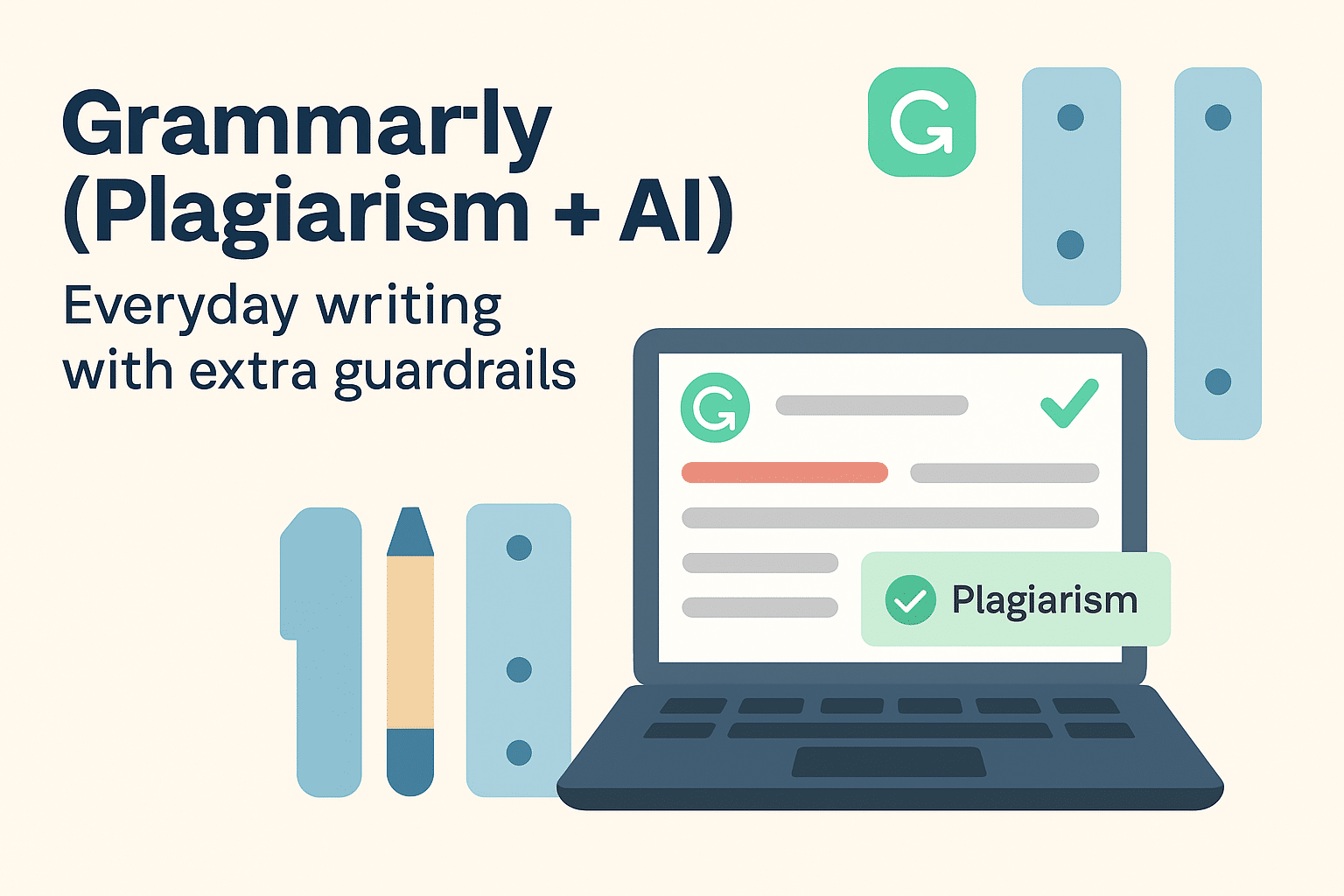
If your students or staff already write inside Grammarly, turning on plagiarism + AI checks is a no-brainer.
Pros: Frictionless; helps reduce accidental plagiarism during drafting. Can check articles for plagiarism.
Cons: Not a specialized academic repository crawler.
Verdict: Perfect “first pass” checker, especially for student writing and day-to-day content.
4) Quetext — Budget checks with a friendly UI
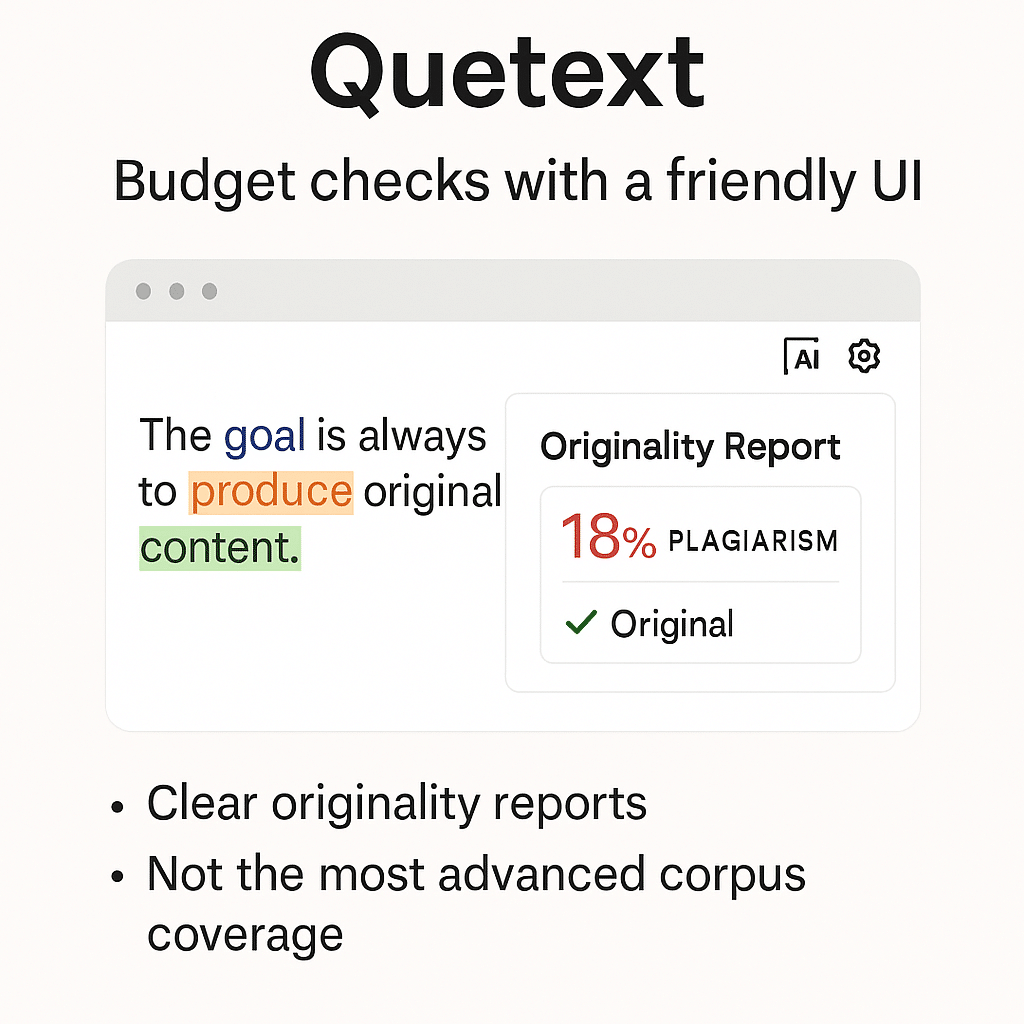
Color-coded feedback is underrated when you’re coaching. Quetext keeps it visual and simple, with AI flags if you need them.
Pros: Affordable; clear originality reports.
Cons: Not the most advanced corpus coverage.
Verdict: Solid value for smaller programs and side-by-side learning moments.
5) Scribbr — Student-centric and explanation-heavy
Scribbr leans hard into teaching. If your priority is coaching students through citations and structure, it’s a helpful fit—with an AI detector available.
Pros: Student resources, clear guidance, AI detection option.
Cons: Not built for institutional scale.
Verdict: Good for tutoring centers and one-off student papers. Scribbr
6) Copyscape — The OG for web/SEO duplicate checks
For site owners and agencies, Copyscape is still a staple. It’s about web originality, not academic archives like the Turnitin website.
Pros: Fast URL checks, batch options.
Cons: No native AI detector; reports are utilitarian. Unlike the Turnitin website, which focuses on academic integrity and student submissions, Copyscape is tailored for web content.
Verdict: Keep it in your SEO toolbox; pair it with an AI-aware tool for AI plagiarism concerns. copyscape.com
7) PlagiarismCheck.org — Straightforward “AI + plagiarism” combo
A practical, no-frills pick for schools and writers who want a single pane of glass.
Pros: Browser extension, Google Docs add-on, LMS options; AI + plagiarism in one.
Cons: Interface is more functional than fancy.
Verdict: A dependable workhorse when you just need solid coverage and simple originality reports. plagiarismcheck.org
Plagiarism Detection in Practice (real-world scenarios & case studies)
Plagiarism detection isn’t just a checkbox—it’s a real-world tool that keeps academic integrity front and center in higher education. Instructors and institutions use plagiarism detection solutions to assess student work, identify potential plagiarism, and ensure that every student submission is truly original.
For example, universities often require students to upload their papers to a plagiarism detection platform before final submission. The system scans the text, compares it against massive databases of published work, and generates an originality report. This report highlights matching text, flags potential plagiarism, and gives both students and instructors a clear view of where citations or rewrites are needed.
Case studies show that when educators consistently use plagiarism detection tools, instances of plagiarism drop significantly. Students become more aware of what’s considered plagiarism, learn how to properly cite sources, and develop stronger writing habits. Instructors, meanwhile, can quickly assess student work, focus on teaching rather than policing, and provide targeted feedback that helps students learn and grow.
The result? A seamless experience that supports both academic integrity and student success. By making plagiarism detection a routine part of the assessment process, educators and institutions help students understand the value of originality and the importance of honest work.
Plagiarism Detection in Practice (real-world scenarios & case studies)
Plagiarism detection isn’t just a checkbox—it’s a real-world tool that keeps academic integrity front and center in higher education. Instructors and institutions use plagiarism detection solutions to assess student work, identify potential plagiarism, and ensure that every student submission is truly original.
For example, universities often require students to upload their papers to a plagiarism detection platform before final submission. The system scans the text, compares it against massive databases of published work, and generates an originality report. This report highlights matching text, flags potential plagiarism, and gives both students and instructors a clear view of where citations or rewrites are needed.
Case studies show that when educators consistently use plagiarism detection tools, instances of plagiarism drop significantly. Students become more aware of what’s considered plagiarism, learn how to properly cite sources, and develop stronger writing habits. Instructors, meanwhile, can quickly assess student work, focus on teaching rather than policing, and provide targeted feedback that helps students learn and grow.
The result? A seamless experience that supports both academic integrity and student success. By making plagiarism detection a routine part of the assessment process, educators and institutions help students understand the value of originality and the importance of honest work.
Bring Transparency (how detection tools foster trust)
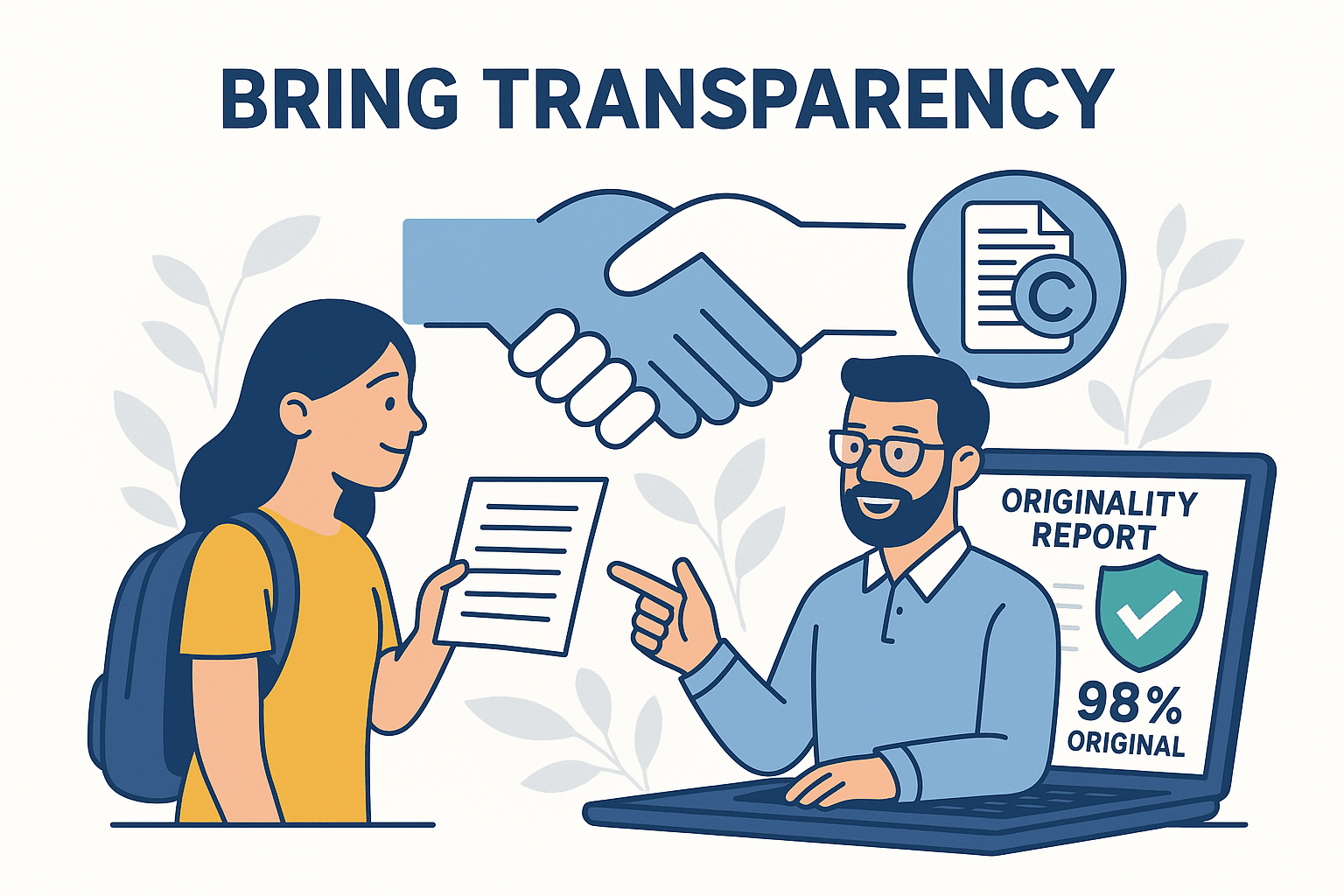
Trust is the foundation of any learning environment, and plagiarism detection tools are key to building that trust between students, educators, and institutions. By integrating these tools into the writing process, educators can bring transparency to every stage of student work—from the first draft to the final submission.
Detection tools do more than just catch duplicate content or copyright infringement. They empower students to double check their own writing, identify areas that need improvement, and ensure their work is truly original before they submit. This not only helps students avoid plagiarism but also teaches them the value of academic integrity and responsible research.
For educators, plagiarism detection tools provide clear, unbiased originality reports that make it easier to identify and address issues early. This transparency reassures students that everyone is held to the same standard, and it gives institutions confidence that their reputation for integrity is protected.
Ultimately, by using plagiarism detection tools, everyone involved in education—students, instructors, and administrators—can focus on what matters most: learning, growth, and the creation of original work. That’s how you foster a culture of trust, support, and academic excellence.
Bonus: AI writing and the new plagiarism reality
AI writing is here, and it sounds…human. That doesn’t make it unethical by default—but undisclosed use in student submissions is a problem. Modern tools spot patterns (perplexity, burstiness, stylistic tells), but again: treat outputs as evidence to review, not verdicts to rubber-stamp. (Even reviewers disagree on “accuracy,” and vendors market aggressively. Use judgment.) Copyleaks
Best practices (this actually helps students)
- Use tools consistently and fairly across student work.
- Publish guardrails: what counts as self-plagiarism, what’s considered plagiarism, how to avoid plagiarism in drafts.
- Pair checks with quick feedback: here’s what to fix, here’s how to cite, here’s what originality looks like.
- Review your stack yearly. The space moves fast; features change. (Example: several mainstream tools now advertise AI detection; others still don’t. Grammarly
FAQs
No. But if students submit model-generated text as their own in higher education, that violates academic integrity policies. Cite use if allowed; when in doubt, ask.
Accidental plagiarism = sloppy citations or paraphrasing too close to source. Consequences can still be serious—educate early.
They’re getting better, especially at surfacing potential plagiarism and AI signals, but they’re not oracles. Use them to guide human review.
Final Verdict
If you need a single recommendation for 2025, pick the tool that’s built for now—not yesteryear. That’s Originality.AI for me: credible plagiarism detection, strong AI signals, clean originality reports, and enough workflow options to actually save you time.
👉 Try Originality.AI — check pricing and scan your next batch with confidence.
