

Crafting LLM Friendly Blog Posts: Tips for Enhanced AI Engagement
Why LLM Friendly Blog Posts Matter Today
ChatGPT, Claude, Google's Gemini, and Perplexity are totally reshaping how people discover content online, and honestly, it's pretty wild! Rather than clicking through tons of blue links (who has time for that anymore?), users often get answers summarized directly by these systems—sometimes without even visiting your site at all. Ouch, right?
That means your blog posts need to be formatted and structured in a way that makes them super easy for LLMs to extract, understand, and quote. Trust me, I've learned this the hard way! In this guide, you'll discover:
What actually makes a blog LLM‑friendly (spoiler: it's not what you think!)
The most effective content formats and structures that work
Technical best practices to boost AI visibility (no rocket science, I promise)
How to write in clear, human‑friendly language that AI loves too

Let's dive in, guys!
Understanding LLMs and Their Role in Search
Large language models (LLMs) are basically AI systems that process and generate human-like language (pretty cool stuff, honestly).
LLMs play a huge role in search by helping search engines understand the context and intent behind what people are actually looking for.
Traditional search engines are evolving to incorporate LLMs, which makes it super essential to optimize content for these models (whether we like it or not).
Understanding how LLMs work and their role in search can totally help you create content that's more likely to be ranked higher in search results.
Core Principles for LLM-Readable Content
Creating content that's easy to read and understand is absolutely crucial for LLMs and human readers alike (win-win situation!).
Using a conversational tone, clear structure, and concise language can seriously help improve the readability of your content.
Incorporating relevant keywords naturally and avoiding overstuffing can also enhance the visibility of your content in search results (nobody likes keyword salad).
Focusing on user intent and creating content that addresses specific needs and questions can help improve engagement and conversion rates big time.
Structuring Content for LLMs
Structuring content in a way that's easy for LLMs to understand is absolutely essential for improving search rankings (learned this one the hard way).
Using header tags, bullet points, and short paragraphs can help break up content and make it way more scannable.
Incorporating internal linking and using descriptive anchor text can also help LLMs understand the context and relationships between different pieces of content.
Creating content with a clear structure and format can help improve the overall user experience and enhance visibility in search results (it's all connected, guys!).
Optimizing Content with AI Tools
AI tools can totally help optimize content for LLMs by analyzing and suggesting improvements to content structure, keyword usage, and readability.
Using AI tools to generate content can also help improve efficiency and reduce the time spent on content creation (honestly, a lifesaver when you're swamped).
However, it's super essential to ensure that AI-generated content is high-quality, engaging, and optimized for LLMs.
Combining human creativity with AI tools can help create content that's both optimized for LLMs and resonates with human readers (best of both worlds!).

Effective Content Formats for LLM Discovery
Walkthrough-Style Tutorials
Forget basic how-to posts. Turn your content into walkthroughs that feel like someone is sitting beside the reader. Use progressive steps, anchor links, and small tips between actions.
Conversational Q&A Threads
Structure FAQs in a natural tone, like real conversations. Instead of robotic Q/A, try embedding emotion or intent in the answers. LLMs prefer content that reflects how people actually talk.
Structured Visual Comparisons
Instead of classic tables, create comparative bullet clusters:
Tool A: Simple UI, medium learning curve
Tool B: Complex but feature-rich
This format is equally scannable and more mobile-friendly for AI parsing.
Listicles with Embedded CTAs
Make your list items actionable. Instead of “Top 5 Tools,” try “Top 5 Tools You Can Try Today (Free Options Included).” LLMs may elevate content that has clear outcomes or micro-CTAs.
Answer-First Definitions
Rather than a dry intro, start with the definition as the first sentence. Then expand on it. Example:
“Prompt chaining is the practice of linking multiple AI prompts together for layered outputs.”
This gives LLMs something to extract immediately.
Original Surveys or User Patterns
Forget quoting industry leaders only—LLMs also prioritize fresh behavioral data, like:
“67% of our users asked about AI snippets within the first 2 minutes.”
That’s insight most articles don’t have.
Minimalist Formatting Wins
Use consistent subheading levels, white space, and clear paragraph breaks. LLMs dislike embedded CSS tricks and custom fonts. Think: clarity > creativity.
Core Writing Principles for LLM Friendly Blog Posts
Use Clear Headings and Subheadings
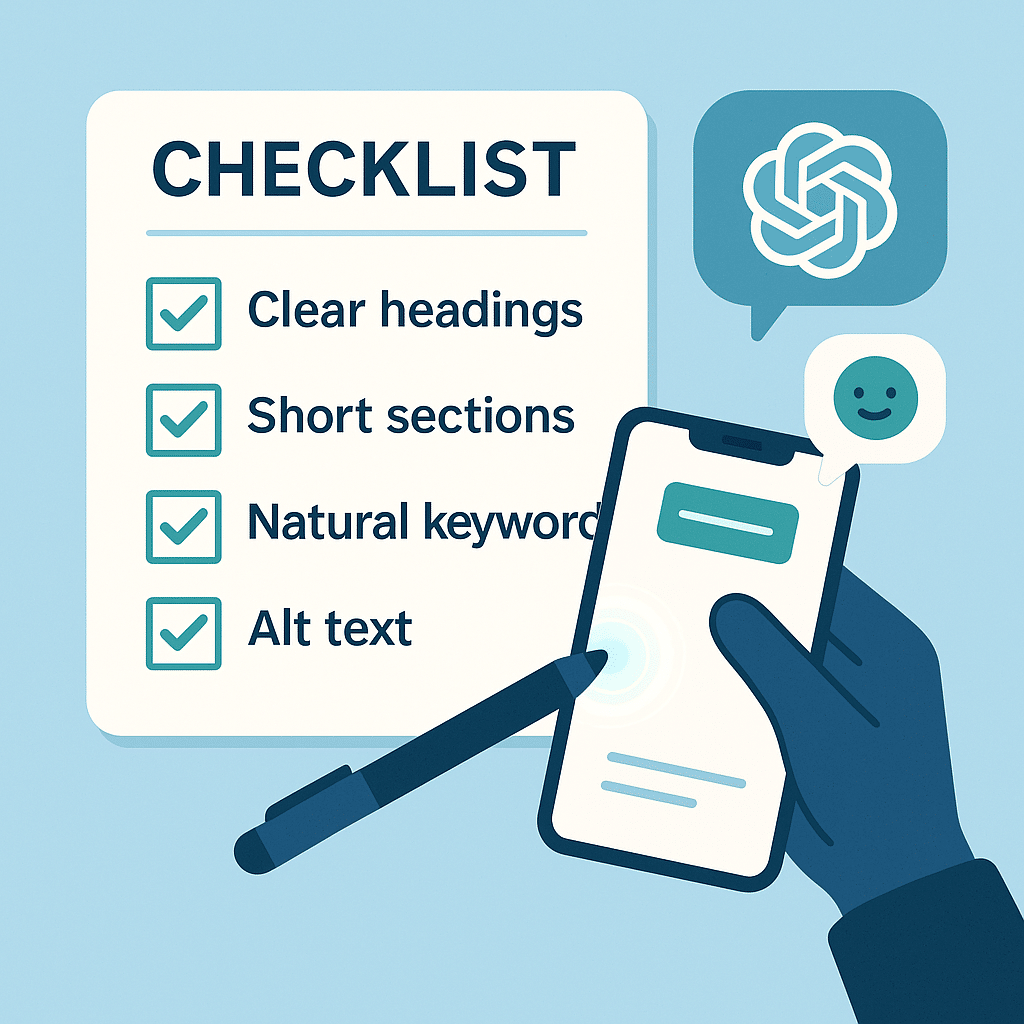
Headings help both humans and AI preview sections (it's like giving them a sneak peek!). Use H2 for main topics and H3 for subpoints. Incorporate natural query-style phrasing in headings - people will thank you for it.
Keep Content Chunked and Consistent
Small sections are way easier to scan, guys! Use bullet lists, numbered steps, or TL;DR sections where helpful. Nobody wants to read massive walls of text anymore.
Write for Clarity and Accuracy
Use simple and precise language. Avoid ambiguous or vague wording (seriously, be specific!). Example: "Supports up to 100 GB of data" is so much clearer than "supports tons of data."
Use Conversational & Semantic Keywords
Write in the natural phrasing people use to ask questions. Include semantic variations, not repetitive keywords (keyword stuffing is so 2010).
Include Summary or Key-Takeaway Blocks
Highlight key points in designated sections that LLMs can quote as-is. It's like giving them the perfect soundbite!
Add Alt Text & Accessible Media
Describe images in alt text so AI systems understand them, improving multimodal capabilities. It's a small step that makes a huge difference.
Technical SEO Setup That Supports LLM Visibility
Implement Schema Markup
Use JSON-LD schema types such as BlogPosting, FAQPage, HowTo, and BreadcrumbList. This helps AI interpret your layout and information (think of it as a translator).
Optimize Metadata
Ensure titles (under 60 characters) and descriptions (around 155 characters) clearly summarize the page's purpose and match natural query language. Keep it snappy!
Internal Linking & Entity Signals
Link related posts with meaningful anchor text. AI learns content relationships from internal networks, improving topical authority (it's all about those connections).
Keep Content Fresh and Accurate
Add "Last Updated" notes and refresh statistics periodically. AI tends to rank fresher content more favorably (they love the latest and greatest).
Optimize Speed, Mobile, and Security
Fast-loading, mobile-optimized, HTTPS-secured pages are more likely to be surfaced or quoted by AI systems relying on page crawling. The basics still matter, guys!
Common Mistakes to Avoid
Real‑World Evidence & Expert Insights
Formats like step-by-step guides, FAQs, listicles, and expert insights are most frequently quoted by LLMs (I've seen this firsthand).
Clear markdown-style formatting consistently improves AI content extraction over overly complex pages.
Structured, AI-consumable content often gets repurposed in chatbots, knowledge bases, and digital assistant responses (pretty cool, right?).
Generative Engine Optimization (GEO) emphasizes clear formatting, user intent alignment, and schema like llms.txt to improve AI quoting and ranking.

Step‑By‑Step Workflow: Create LLM‑Friendly Blog Posts
Choose your blog format: how‑to, FAQ, listicle, comparison, or definition (pick what feels right for your topic).
Outline main headings that reflect user queries.
Write sections in short paragraphs under each heading (keep it digestible).
Add FAQ or summary sections.
Include key takeaways or TL;DR boxes (your readers will love you for this).
Embed appropriate schema markup (JSON-LD).
Add alt text to any images.
Use natural, conversational phrasings (write like you're talking to a friend).
Publish and then test how AI tools (ChatGPT, Perplexity, Gemini) summarize or quote your content.
Monitor AI-mode impressions via Search Console and engagement metrics in Google Analytics (this is where the magic happens).
How to Measure LLM Visibility Success
Use AI mode impressions in Google Search Console to track articles appearing in AI-generated panels (super useful stuff).
Test summaries by asking ChatGPT, Gemini, or Perplexity to answer specific prompts referencing your topic.
Engagement metrics (dwell time, click-through rate, scroll depth) show user satisfaction, signaling importance to AI.
Watch for external brand mentions or quotes in Q&A forums—these act as entity signals to LLMs (it's all connected, guys).
Summary: Why LLM‑Friendly Posts Should Be Part of Your Strategy
LLMs are rapidly becoming primary content discovery engines, and honestly, it's happening faster than most of us expected! Structuring posts thoughtfully increases the chance you'll be quoted in AI-generated answers—even without traditional top SEO rank (pretty amazing, right?).
Proven formats include how‑to guides, FAQs, listicles, expert quotes, definitions, and simple markdown. Technical supports like schema, readability, internal links, and alt text make your content way more AI‑friendly.
Avoid pitfalls like dense text, keyword stuffing, vague content, and missing structure (trust me, I've made these mistakes). Measure success by tracking AI-mode impressions and user engagement metrics.
The best part? If you stick with these strategies and keep pushing through, you'll see results. It might take time (it took me longer than I expected), but the payoff is totally worth it. Keep going, guys! 🙂
