

The Top LLM Visibility Tools for Enhanced SEO Performance in 2025

Disclaimer: My site is reader-supported. This may contain affiliate links, and I may receive compensation at no cost to you if you purchase the products that I reviewed and stand for through these links. Learn more in my Privacy Policy.
LLM visibility refers to the ability to monitor and optimize how large language models (LLMs) reference and rank content across AI systems.
LLM observability tools are essential for maintaining brand visibility in AI-generated answers beyond traditional Google rankings.
AI search visibility is critical for businesses to succeed in the evolving search landscape, where AI search engines are transforming SEO.
Brand visibility tracking is necessary to ensure that a brand’s presence is accurately represented in AI-generated responses.
Importance of Monitoring Tools
Key Features and Benefits
7 LLM Visibility Tools

2. Otterly AI
Ideal for small teams and startups seeking simplicity:
Lightweight platform focused on mentions in ChatGPT, Perplexity, and Google AI Overviews
Easy to set up—alerts notify you when your domain appears in an AI response
Tracks when your brand is linked or referenced—even in summary snippets
Otterly is user-friendly, giving immediate visibility and alerts without requiring an SEO team.
2. WriteSonic
Best for brands that want both AI visibility insights and hands-on tools to optimize content performance:
AI Presence Tracking: Monitor brand mentions, citations, and sentiment across Google AI Overviews, ChatGPT, Perplexity, Grok, and more.
Prompt Intelligence: Analyze real AI user prompts to guide strategy beyond traditional keywords.
Optimization Hub: Prioritized tasks for filling citation gaps, improving outdated pages, and resolving technical issues.
SEO & Content Suite: Built-in keyword research, clustering, and AI-assisted content creation streamline workflows.
Performance Analytics: Track AI-driven traffic, query volume, and crawl behavior for a complete visibility picture.
Writesonic is a blend of monitoring, analysis, and execution that makes it ideal for teams adapting to the shift from keyword-driven SEO to prompt-driven AI search.

3. SE Ranking’s AI Visibility Tracker
A brand‑focused AI tool built into SE Ranking's SEO suite.
Tracks brand mentions and links in ChatGPT, Claude, and Google AI Overviews
Allows prompt simulations to capture your brand’s presence
Offers competitive comparisons and timeline trends
Converts AI visibility into clear forecasts for marketing strategy
Great if you’re already in the SE Ranking ecosystem and want a smooth entry into AI monitoring.
4. Semrush One
Built for how people search today
Semrush One is where you track, optimize, and win—everywhere customers search.
One connected solution for Google, AI search + GEO. One plan.
Built for teams big and small
- Combines both an SEO toolkit + an AI-visibility toolkit: you get traditional SEO features (keyword research, site audit, rankings) and visibility tracking in large language models (LLMs) such as ChatGPT, Gemini, Perplexity.
Helps you monitor brand mentions, prompts and visibility in AI search platforms (not just Google/Bing).
Keeps all data in one platform — so instead of juggling separate tools for SEO + emerging AI search visibility, you access everything in one place. (Good for streamlining workflows when you’re managing multiple client projects.)
Lets you stay ahead of the curve by optimising for “AI discovery” — which is relevant given how search is shifting.
Supports typical SEO agency functions: keyword research, competitor analysis, site health auditing, backlink insights. These are core for your client base (service‐industry businesses).
Offers data updates on a regular cadence (daily/weekly depending on toolkit) so you can rely on up-to-date information.
Enables you to present more advanced, forward-looking value to clients (e.g., “we’re monitoring how you show up in AI search as well as in Google”) — which can help you position your agency as premium and future-ready.
Perfect if you want a seamless blend of SEO and AI visibility monitoring within one platform.

5. Keyword.com AI Rank Tracker
Full-featured AI monitoring tool for multiple models:
Tracks brand mentions across ChatGPT, Claude, Gemini, Perplexity, and Google AI Overviews
Identifies linked pages and direct citations in AI responses
Shows which queries or prompts trigger mentions
Helps optimize pages based on AI visibility gaps
Ideal for content teams focusing on prompt-aligned SEO and AI-aware content creation.

6. Scrunch AI
A purpose-built tool for Generative Engine Optimization (GEO):
Monitors brand presence in ChatGPT, Claude, Gemini, and other AI platforms
Tests prompts, audits content for AI discoverability, and tracks share-of-voice
Offers persona-based query testing to figure out which prompts drive mentions
Helps refine content so AI systems pick it up more often
Perfect for brands serious about designing for AI-first response formats.

7. Peec AI & Profound
Mentioned in marketing circles as enterprise-level options:
- Peec AI tracks brand presence, sentiment, and ranking across ChatGPT and Gemini
- Profound provides advanced ranking analytics across multiple AI platforms
- Both tools benchmark performance and measure sentiment over time
Well-suited to medium-to-large organizations needing robust AI visibility and analytics dashboards.

8. Nightwatch / Rankability / Knowatoa AI
These are hybrid SEO‑AI tools that combine traditional ranking and AI visibility:
Nightwatch extends its SERP tracking to include ChatGPT and other AI platforms
Rankability and Knowatoa offer prompt-based brand visibility tracking
Provide integrated dashboards covering both “blue link” SEO and AI quote-level insights
Great for teams seeking a panoramic view of search performance, blending both SEO and AI visibility workflows.

9. Chosenly.com (LLM visibility platform)
Chosenly.com (LLM visibility platform)
Best for B2B companies focused on revenue, not just visibility.
- Breaks LLM ranking and optimisation into clear sub-problems, with ownership distributed across Content, Product Marketing, PR, Brand, and Legal teams.
- Content teams get clear guidance on what to create: keywords with high, medium, and low competition (based on actual LLM citations), the right formats to use, and the exact content styles that boost ranking odds.
- Product marketing teams can see the criteria LLMs use to compare solutions: pricing, integrations, support, compliance, and more and learn where they have the “right to win.”
- PR teams get visibility into misrepresentations or hallucinations in AI outputs, along with a plan to correct them through PR campaigns, content updates, or outreach.
- Personalised onboarding ensures accurate tracking of your keywords, personas, and ICPs, backed by ongoing weekly calls and a dedicated Slack channel
Perfect for B2B teams serious about tracking traffic, conversions, and pipeline from LLM searches (ChatGPT, Gemini, etc.) by integrating directly with GA4, Search Console, and CRM.
10. RivalSee
Best for: Agencies and businesses who need to present and optimize AI visibility by customer segment. Perfect for teams who want to see the actual search terms AIs use and create content that gets recommended for each customer persona.
Persona-driven AI visibility platform that tracks how different customer segments find you:
* Uses dynamic customer personas instead of keywords - mirroring how AI actually generates personalized answers for different user segments
* Benchmarks your AI visibility against direct competitors for each specific customer segment, uncovering critical performance gaps.
* Tracks your progress across all major models: ChatGPT, Claude, Gemini, Perplexity, and Google AI.
* Shows you the exact search terms AIs use to find information and creates optimal content for those queries.
* Identifies which sources appear in each AI result and how you compare to competitors across segments and individual questions
* Agency Mode manages multiple clients with co-branded reports
Search Optimization Strategies
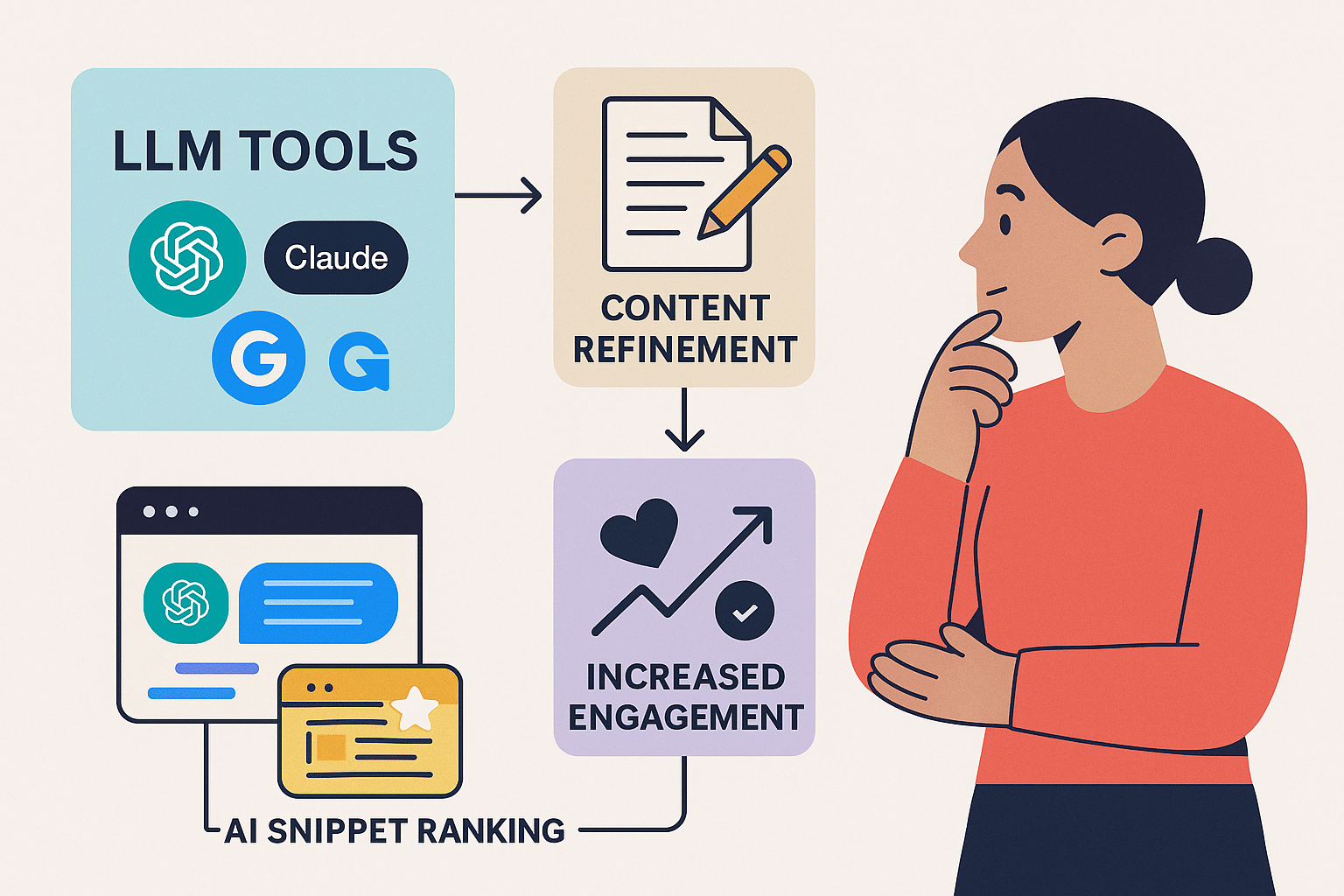
Implementing LLM observability is crucial for search optimization, as it helps track brand visibility and performance metrics.
LLM tools provide actionable insights to refine content, boost engagement, and increase conversions.
Traditional search optimization strategies must be adapted for AI search platforms, where retrieval augmented generation and Google AI Overviews are becoming increasingly important.
Brand monitoring tools help track brand mentions and sentiment analysis across multiple AI platforms.
Choosing the Right Tool
Setting Up LLM Monitoring
To set up LLM monitoring, identify priority AI platforms and queries relevant to your business.
Configure your monitoring tool settings to track brand mentions, sentiment analysis, and competitor benchmarking.
Establish baseline metrics and KPIs to measure brand performance and track progress over time.
Set up alerts and reporting workflows to drive decisions and optimize brand visibility.
Strategies for Improvement

Use sentiment analysis to address negative sentiment and improve brand perception.
Conduct competitive benchmarking and analysis to discover effective strategies and content gaps.
Implement cross-platform LLM monitoring to track brand visibility across multiple AI platforms.
Leverage share of voice data to identify competitor dominance and opportunities.
Best Practices for LLM Visibility
Monitor brand visibility regularly to stay up-to-date with changes in AI search results.
Use LLM tools to track brand mentions and sentiment analysis across multiple AI platforms.
Implement generative engine optimization (GEO) strategies to improve brand visibility in AI search results.
Stay up-to-date with the latest developments in AI search and LLM technology.
Common Challenges and Solutions
Future of LLM Visibility

The future of LLM visibility is rapidly evolving, with new AI search platforms and tools emerging.
Traditional search engines are integrating AI-powered features, and new AI-driven search platforms are emerging.
Users are increasingly relying on AI chatbots for brand recommendations and insights, making LLM visibility critical for businesses.
Staying ahead of the curve in LLM visibility is essential for businesses to maintain a competitive edge.
Conclusion
LLM visibility is critical for businesses to succeed in the evolving search landscape. LLM observability tools provide actionable insights to improve brand visibility and track brand mentions across multiple AI platforms.
Implementing LLM observability and using LLM tools can help marketing teams monitor brand performance trends and improve AI search presence.
By staying up-to-date with the latest developments in AI search and LLM technology, businesses can maintain a competitive edge and improve their brand’s visibility in AI search results.
