

Discover the Best AI Checkers for Accurate Detection
Look, AI is everywhere. It’s writing blog posts, student essays, tweets (sorry, “X” posts), even love letters. And while some of it is impressive, a lot of it is… well, let’s just say if you’ve read three ChatGPT essays, you’ve basically read them all.
That’s why AI checkers (aka AI detectors, aka “that little security blanket teachers and editors cling to”) are blowing up right now.
If you’re in education, SEO, or just want to make sure the intern didn’t outsource their “original thought” to ChatGPT, you need these tools.
In this guide, I’m breaking down the 6 best AI checkers for 2025. I’ll tell you what they’re good at, where they suck, and whether they’re worth your time. No sugarcoating.
Oh, and side note: don’t expect perfection. AI detection isn’t some magical lie detector. It’s more like that suspicious aunt at dinner who thinks she knows who’s lying, but sometimes accuses the wrong person.
Why Do We Even Need AI Checkers?

Before I dive into tools, let’s quickly talk about the “why.”
Education: Professors are panicking. Universities don’t want students handing in essays fully written by AI. (And yeah, students are panicking too.)
SEO & Content Marketing: Google’s been wishy-washy about AI content. First, it was “don’t use it.” Then it was “just make it helpful.” The truth? AI checkers help keep content human enough to avoid penalties—and the AIO Writer approach could be the future of creating quality content.
Publishing & Journalism: Integrity matters. You can’t slap your byline on something that’s 100% machine-generated.
In short: AI-generated content is fine, but knowing when it’s creeping in too much is key. That’s where AI detection tools come in.
How Do AI Checkers Actually Work?
Here’s the nerdy bit (skip if you hate tech jargon).
They analyze text patterns—AI tends to be too neat, too predictable. Humans? We ramble, we contradict ourselves, we misspell stuff.
They run your text through an AI detection model that compares it to known AI writing styles (think ChatGPT, Claude, LLaMA models, Google Gemini, etc).
They spit out a probability score—like “87% chance this was written by AI.”
Are they always right? Nope. False positives are common. That’s why I always say: don’t use them as the judge, jury, and executioner. They’re more like your nosy sidekick.
The 6 Best AI Checkers in 2025
Alright, the meat and potatoes. These are my picks for the best AI checkers right now.
1. Winston AI – The “Only AI Detector” (Their Words, Not Mine)
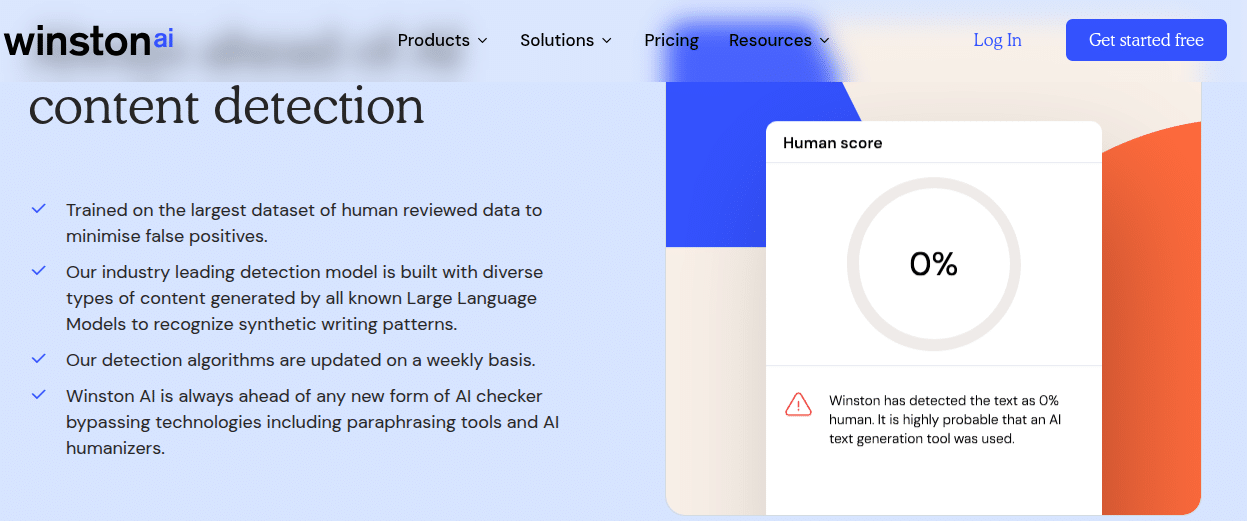
Winston AI brags about being the only AI detector with 99.98% accuracy. Bold claim, right? Honestly, I’ve tested it, and while it’s good, I wouldn’t tattoo that percentage on my arm just yet.
Features:
Crazy-detailed reports (PDF export is nice for schools).
Works well with Google Docs & PDFs.
Can detect both AI-generated content and straight-up plagiarism.
Decent at spotting text “humanized” by tools like Undetectable AI.
What I like: It’s user-friendly. Even my non-techy cousin figured it out.
What I don’t like: It’s pricey. Also, false positives still happen if your writing style is too “clean.”
So, I tossed in one of my old SEO blogs into Winston AI just to see if it could smell the human coffee stains on it.
Guess what? It flagged me at 35% AI-written. Bruh, I wrote that piece while my cat was screaming at the window and Spotify was on shuffle. No AI in sight.
On the flip side, I dropped in a ChatGPT draft I hadn’t touched, and Winston nailed it—called out the robotic tone immediately. Verdict? Pretty sharp, but can be a little too skeptical about us messy humans.
2. Grammarly (with AI Checker Add-on)
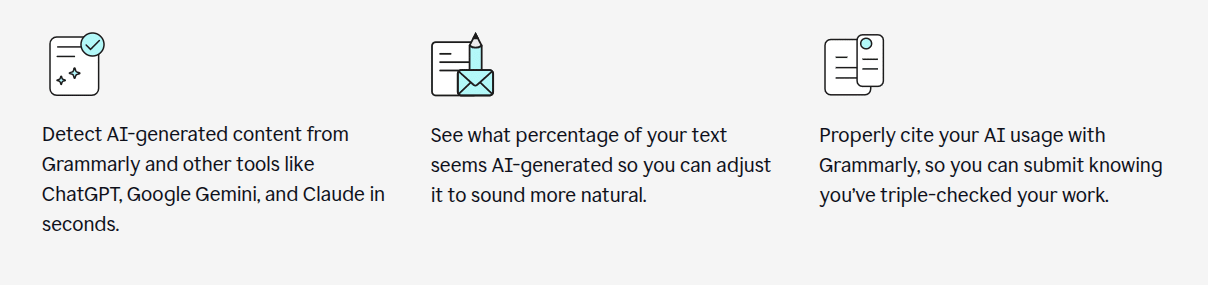
We all know Grammarly as the grammar checker that nags us about commas. But now, it’s jumped on the AI detection train.
Features:
Grammar + plagiarism + AI detection in one dashboard.
Chrome extension for real-time checking.
Helps with writing skills feedback (not just detection).
Pros: Easy for students & professionals since everyone already uses Grammarly.
Cons: Detection accuracy isn’t as strong as Winston AI. But hey, it’s bundled with grammar tools, so that’s a win.
Grammarly isn’t technically an AI detector (it’s more like your judgmental English teacher who never chills), but I still tried running a chunk of content through it.
It didn’t scream “AI!” but the way it nitpicked my tone and suggested I “add more clarity” low-key felt like a bot whispering “I know what you did.” I’d say Grammarly is more about polishing than detecting, but if you paste an AI essay, the monotone structure stands out when it keeps suggesting the same dull edits.
3. ZeroGPT – The Free Crowd Favorite
If Winston is the “Mercedes” of AI detectors, ZeroGPT is like that old Honda that somehow never dies.
Features:
Free AI checker (yes, really free).
Highlighted analysis shows which parts of text look AI-generated.
Multi-language support.
Pros: Free account, easy to use, surprisingly solid for detecting AI text.
Cons: UI feels outdated, and sometimes it screams “AI-generated” even when it’s just bad human writing.
Alright, this one’s funny.
I dumped one of my client’s newsletters into ZeroGPT. It was 100% human, written with slang and typos, and this thing had the audacity to scream “AI-generated, 78% probability.”
Like, come on.
Then I tried a straight-up ChatGPT essay with all the “Furthermore, in conclusion” nonsense… ZeroGPT didn’t hesitate—called it out instantly. So yeah, it’s kinda like that paranoid friend who thinks everyone is lying, but sometimes, they’re right.
4. Copyleaks AI Content Detector
Copyleaks started as a plagiarism detector but quickly pivoted into AI content detection.
Features:
API access (great for schools and businesses to integrate).
Works with Google Docs.
Can check academic papers, essays, and even code.
Pros: Solid enterprise solution.
Cons: Not really built for casual users—it’s more academic/institutional.
Copyleaks feels like the detective that doesn’t talk much but delivers receipts.
I uploaded a mix of human blog + AI filler paragraphs, and boom—it actually broke down which sentences were sus.
Super cool. I will say, though, if you use a lot of structured lists (like I do when I’m too lazy to write real paragraphs), it sometimes thinks “yep, that’s AI.” Still, pretty reliable.
5. Originality.AI
Marketers swear by this one. If you’re in SEO, blogging, or publishing, this is probably your best bet.
Features:
AI detection + plagiarism detection combo.
Team collaboration features (you can add multiple users).
Chrome extension for real-time content checks.
Pros: Super accurate with AI-generated blog posts.
Cons: Paid only. No free version. Also, overzealous sometimes—labels human text as AI.
Read our review: Is Originality AI Accurate?
This one’s built like it’s on steroids. I tested it with a 50/50 mashup: half my messy draft, half AI-polished.
And man, it called me out. It literally highlighted the polished half as “AI.” Like, don’t expose me like that! 😅
Originality.ai is definitely for people who want hardcore accuracy, but be warned—it’s paid, and not exactly cheap.
6. Sapling AI Checker

This one flies under the radar, but it’s pretty neat.
Features:
AI content detection for emails, customer service scripts, and documents.
Grammar + spelling checker baked in.
Integrates into business workflows (think call centers, chat support, etc).
Pros: Great for business communication.
Cons: Not as powerful for long-form content detection.
Sapling AI feels like the low-key one in the group.
I tossed in a blog draft I wrote at 3 AM, and it didn’t accuse me of being a robot (thank you). But when I tried a generic AI essay about “the importance of time management,” it spotted it.
So, I’d say Sapling is less paranoid than ZeroGPT but not as precise as Originality. Good for casual checks, not courtroom-level evidence.
My Messy brain dump
FAQs about AI Checkers
Q1: Are AI checkers 100% accurate?
Nope. Not even close. Winston AI claims 99.98%, but in reality, false positives and false negatives happen a lot. Use them as guidance, not absolute truth.
Q2: What’s the best free AI checker?
Probably ZeroGPT. It’s not perfect, but hey, it’s free.
Q3: Can AI checkers detect text from ChatGPT?
Yes, most can. But if someone heavily edits the text, the detection score drops.
Q4: Do Google Docs integrations work well?
Yes, tools like Winston AI and Copyleaks integrate with Google Docs and Google Classroom, making life easier for teachers.
Q5: Is Grammarly’s AI checker good enough?
It’s okay. Think of it as a sidekick, not the main detective.
Q6: Are AI detectors bad for writers?
Not really. If you’re writing original stuff, you’re fine. If you’re heavily leaning on AI, yeah, you’ll get caught eventually.
Wrapping It Up
So, which is the best AI checker in 2025?
For a comprehensive comparison, check out the best AI writing tools to find options that fit your needs.
AI detection isn’t going away anytime soon. If anything, it’s becoming part of the writing process itself. Just remember: no tool is perfect. Trust your gut, mix in some human judgment, and you’ll be fine.
👉 Want to try one right now? Go test Winston AI or ZeroGPT. Play around. See how your own writing scores. You might be surprised.
